Resume

Education

University of Utah, David Eccles School of Business

Bachelor of Science in Entrepreneurship (Major anticipated)     May 2020

  • GPA of 3.68
  • Awarded a scholarship for the Greg Goff Strategic Leadership Fellowship and participated in the year long program to plan and implement substantial real-world changes in major organization

Experience

Little Dutch Boy Bakeries, Inc.

Night Manager

Draper, UT May 2014 – Present

  • Coordinated the work of 25+ individuals to consistently meet production requirements
  • Designed a detailed layout and product flow for a new facility which substantially increased production capacity
  • Hired, fired and resolved conflicts amongst employees improving the shifts ability to meet production demands
  • Successfully made emergency repairs on numerous occasions to critical production equipment to fulfill major orders
  • Created several packaging designs which showed significant increase in product sell through

Christensen & Hymas, LLC

Marketing Assistant / Social Media Manager  Oct 2011 – May 2014

  • Responsible for the development of social media strategies which grew our Facebook following by over 30% in 2 years
  • Created and managed email campaigns to new and prospective clients which helped increase client awareness and understanding of the legal process
  • Managed a team of 5 to create content for TV, radio and blogs which increased website traffic and high-profile cases

Skills

  • Proficient in Adobe InDesign, Illustrator, and Photoshop
  • Proficient in Fusion 360 and Sketchup for 3D design
  • Fluent in Spanish

Volunteer

Full-Time Volunteer Representative

Religious Organization

Lima, Peru Jan 2009 – Jan 2011

  • Developed strong work ethic by working 12 hours a day to meet specific goals
  • Planned, organized, and taught 2-4 workshops of 16+ individuals each week on goal setting, relationship building, and leadership skills for 6 months
  • Increased volunteer effectiveness by providing training in individual communication, problem-solving, and productivity skills for 168 volunteers
  • Wrote and edited a weekly newsletter in Spanish for 6 months

Interests

  • Outdoor activities, including: dirt biking, hiking, skiing, snowboarding and wake surfing
  • Artisan bread baking
  • 3D design and printing

My Dearest Comcast,

We are contractually bound. You have set the terms of the contract; I agree to pay you and you agree to provide the service as stated in the contract. I don’t expect anything more. But I take issue when it requires multiple phone calls, tech support staff, and sales representatives who don’t know/can’t resolve multiple problems that should never have arisen in the first place. I get handed off to somebody else; it’s always somebody else’s problem.

I sincerely wish I could hand you off to somebody else to fix my problems. That would sure make my life easier. Unfortunately, I don’t have that luxury. I am the one who has spent upwards of 10 hours on the phone to resolve problems that shouldn’t have ever existed. That’s my time and money wasted.

Here’s a list of grievances I’ve had with your services. I consider them, in the fullest right, moments when our agreement has not fulfilled by you, Comcast:

  1. Even after verifying that it was okay to use my own modem I found you were billing me to “rent” my own modem. It took 3 specialists and several hours of my Saturday to get the fees cancelled and reimbursed.
  1. The Comcast sales representatives, who originally sold me the service, failed to disclose that prices double ($30 to $60 for 8mbps) after six months. You may argue it was in the contract, and I am sure it was, but the sales representative did not read me the contract over the phone. He had me pay before ever receiving such information. Are all sworn to your vast two-faced conglomerate establishment trained in such deceitful traditions? Bait and switch anyone?
  1. We moved to a new home in March of this year. It was new construction and hoping that my experiences were just flukes I decided to go forward with transferring my service to my new location. Naturally you had to come out to get the house ready, I get it. A week of waiting, $40, and two visits later several unqualified “technicians” bungled through connecting the wires in the box on the side of our house. They outright failed on the first visit and they had to come back a second time. They also got into the coaxial panel in the mechanical room and left all the wires hanging out; I had to find the cover and screws and stuff the wires back in myself. They didn’t even leave a connection for my modem. Remind me why I paid for that?
  1. Several month later and very much to our surprise, the service we requested be transferred from our apartment to our new home was still active and we were still being billed the $60 for 8mbps in the apartment we weren’t living in. What more, that apartment complex has only Comcast internet and the poor family that moved in wasn’t able to get their own service started because it was still under my name. You did NOTHING to solve their problem. No initiative to figure out why they couldn’t get internet. When they finally got in touch with my wife and I, they said the representative told them it wasn’t their problem and there’s nothing they could do. With our records literally at your fingertips, you could have easily figured out who the previous residents were and taken the initiative to solve the problem. I would have been thrilled to know sooner that I was still being charged for that service. Instead, you dumped the burden on me, the customer, to find the problem and take another 3 hours and transfers to two different technicians to get it resolved. I am satisfied with the minimum resolution of a reimbursement for the months I didn’t pay for (it still doesn’t come close to covering the headaches and hours I’ve wasted speaking to customer support). Even though my problem was fixed I still believe something is owed to that family who had to dig up our records and reach out to ask us if we could do anything. That’s your customers solving your problems.
  1. Apparently, when a customer service representative discontinues service in an old location they also deactivate your current account then create a new account and keep it a secret. At least that’s what happened to me. Consequently, I spent another hour in a chat window with two different representatives (for some reason the first can never handle it), and still, they did not resolve the problem. I had to explain the problem to each of them multiple times (no offense meant but they didn’t speak English very well) and when what I was saying finally clicked with the third gentlemen, he asked a question at the same time I got called out of the room for 5 minutes and he ended the chat with me. More time wasted. I have to go through all that again.
  1. My second attempt fixing the ‘double account’ issue. The customer service representative did not understand what I was saying. Let me be clear, I have no problem with outsourced customer support staff but I do have a problem with a company hiring an individual to do the job of helping their customers that cannot help because he or she does not speak the customer’s language. Writing the same thing over and over in slightly different variations is highly frustrating. And even at that, he failed to fix my problem. He too decided it was best to transfer me to another customer support agent and then left the chat without ever transferring me. I have to go back yet again and plead to have the problem fixed.
  1. This one is about money (you knew it was coming). When we had service transferred you our new home, my new local Comcast representative, noticed that we were paying a lot for a wee little 8mbps. He truly is a genuine guy, who I happen to quite like, and he told me about an updated service plan that would cost less than our $60 and give us faster speeds. We really don’t need faster internet but at $30 per month how could we refuse? That was until I noticed our monthly bills coming back at $40. I thought maybe he misspoke when he initially told me about the service so I let it slide. As if by magic, the price of my service has since increased and not even after a year. My bill for this month is now $50.99. It just keeps creeping up. My, my, Is this the second bait-and-switch in our relatively short relationship?

Why does it have to be this way? I see your ads saying that you’ve “changed.” I’m calling BS. Have you ever had to come after me for money? In the entire time I’ve been a customer, has there ever been a single instance where I haven’t paid my bill on time? I keep my end of the bargain. Why is it so hard for you to keep yours?

We are contractually bound. I would love to find an honorable internet provider that is true to that agreement and won’t cause me ulcers and waste my time with problems that should never have existed. I would love to shop around for another provider; unfortunately you have a monopoly on my street, so no luck there. If I want internet, which I need for work and I like for a little family time, I, an unhappy customer, am stuck with you. So please, my dearest Comcast, fix your crap.

International Film Critique

I recently had the chance to view Ip Man, an international martial arts film made in 2008 and directed by Wilson Yip. The film is entirely in Cantonese with English subtitles and stars Donnie Yen, Simon Yam, Ka Tung Lam, Siu-Wong Fan, Lynn Hung, Hiroyuki Ikeuchi, Tenma Shibuya, Yu  Xing, Chen Zhi Hui, and You-Nam Wong.

Ip Man starts the audience off in 1935 Fo Shan, China. At the time, Fo Shan was renowned for its martial arts practices and had many schools teaching various forms of hand-to-hand fighting. The film follows the titular character, Ip Man, a Master of the Wing Chun form of martial arts. As one of, if not the best and most respected martial arts Masters in a community of over 300,000 people Ip Man lives a life of fortune and happiness with his wife, Cheung Wing-Sing, and young son, Ip Chun. Everything changes when China is invaded by the Japanese in 1937. The subjugated people of Fo Shan are killed by brutality and starvation; the population of Fo Shan is whittled down to a mere 70,000 people. Everyone is affected by the occupation; Ip Man and family are evicted from their home and are forced to live an abject lifestyle. Ip Man makes strides to protect his family and his people. Through duels and impromptu fights Ip Man eventually gains the attention of Miura, the Japanese General, and challenges him to a duel. Upon winning, Ip Man is shot and the outraged community rebels against their oppressors.

Ip Man takes a look at moral principles and uses characters and events to juxtapose different schools of thought. Ip Man’s calm demeanor is often contrasted with the rage and violence of characters around him. Always seeking for good, Ip Man is the white knight on who the entire community can depend. Very early on in the film, Ip man has a friendly, private duel with a Master of a neighboring school. The duel is accidentally seen by another man retrieving a kite from a tree who later tells the whole town and leads the embarrassed Master to demand satisfaction. Ip Man intervenes, is threatened by a police officer and effortlessly disarms him and treats him to dinner. In this sequence an unforgiving code of pride is extinguished as quickly as the the juxtaposed flagrant brandishing of firearms as a source of individual power is disarmed and kindness rushes to replace it. These juxtapositions happen throughout the film. The defection of a main character to Japan’s army stands contrasted with Ip Man’s patriotism and loyalty to the Chinese people.

Everybody is human and the actual Ip Man is no exception, however, I think the filmmakers chose to show him as in such an infallible light because that way he becomes a symbol of what the view should strive to be like. The filmmakers want to show that there are multiple ways of responding to situations but in every instance, there is an appropriate path and Ip Man is meant to teach the audience that path. He does this generally by example, but also through a few profound, thought provoking statements.

Ip Man’s message is one of tolerance, honor, integrity, and dedication. I found the morals the film presented engaging and compelling. I feel that our society cares less and less about those traits which were once deemed honorable; the development of which worthwhile. Now our moral compass doesn’t point north, its ability to direct our people eroding little by little. What once was north may now be south. What the Ip Man makes me feel is that there is still a reason to do good, that it does make a difference, even as the protagonist made a difference in his world by holding fast to those principles.

It was refreshing to see such a movie that was so morally compelling as well as highly entertaining. It seemed to never have a dull moment and helped me to see that the careful application of dedication to a cause will pay off in the end. I was actually quite surprised to see the Japanese in such a different light. As the main antagonist, Japan seems brutal, violent, and full of an over-zealous sense of conquest. This was very different than my views of the Japanese going into the movie. My wife and I had just finished watching The Last Samurai which shows the Japanese in a very different light. I think Ip Man helped to expand my perspective of the Japanese and Chinese cultures as well as their relationship. I know that both Ip Man and The Last Samurai have very embellished plots but the perspectives of those who made the films about that culture still shines through the work. The creators of Ip Man have a tainted view of the Japanese because of what they did at this time to their people. I think it is wise to consider this perspective and contemplate why it exists, because there must be a valid reason for presenting the Japanese with such cruelty.

Ip Man helped me see another culture in a whole new light. The majority of exposure to the chinese lifestyle came from my childhood visits to Chinatown and poorly dubbed kung-fu movies, creating in my mind an image of cheap products and a propensity for violence. Ip Man was made by filmmakers who have lived their lives in China and are able to tell a much more complete story than Shanghai Nights ever could. The filmmakers showed traditional Chinese architecture and dress. Little shops in crowded streets filled with people who know each other’s names. The speech of the people of Fo Shan was largely shown as very respectful, with a totally different sense of humor than what I’ve grown accustomed to. I could tell that some parts of the film were meant to be seen as funny, but I they just didn’t make me laugh.

I learned about the Sino-Japanese War, which started before and eventually merged with WWII and ended when Japan surrendered after the bombings of Hiroshima and Nagasaki. I’m actually a little ashamed I didn’t know anything about it before. I knew that the Japanese had invaded China, but I thought that was limited to post December 7, 1941 WWII Japanese conquest.

This film was definitely more artistic than the standard Hollywood summer blockbuster. As I watched the film I got the feeling the filmmakers poured their heart and souls into making this film come to life. It also differed in that despite being made fairly recently, Ip Man uses no computer graphics. Additionally, unlike other notable Chinese films like Crouching Tiger, Hidden Dragon, Ip Man doesn’t use and wires for it’s combat sequences; instead it’s all expertly choreographed by Sammo Hung and brought to life by talented actors.

I noticed that in the beginning of the film the filmmakers chose to do most everything in brighter colors. After the Japanese army moves in the colors all change to well-lit but very under saturated tones. The music was also more typical of Asian countries with heavy falling drum beats with strong string accompaniment, leaving out the classic rock and roll style music found in many Hollywood pictures. It’s interesting as well that in many intense scenes instead of relying on the music to help the audience feel the importance of scene the filmmakers chose to let silence and solid acting performances do the work, and with much success, in my opinion.

One final but important thing I noticed about the film was that there was violence, yes, but not excessive violence coupled with sex. The film was devoid of anything scandalous and instead focused on the importance of relationships between friends and family, oftentimes dropping hints about the importance of caring for and spending adequate time with one’s family.

I would highly recommend Ip Man – it’s now at the top of my favorite foreign films list.


Free or Equal?

The following is a series of questions and responses based on the Free or Equal documentary on Free to Choose, a network dedicated to providing information on economics. In Free or Equal, Swedish author, commentator and Cato Senior Fellow Johan Norberg takes us through some of Milton Friedman’s economic theories by showing us some of the places that inspired his ideas.

Before this assignment, I knew nothing about Hong Kong’s incredible rise from the slums to one of the most productive economies in the world. Along with many others, Free or Equal gives Hong Kong’s history as proof that a free market economy is the fastest way to lower poverty and higher standards of living. It’s interesting to compare very regulated economies to those with few regulations. I am reminded of our own economy and its apparent turn towards a more regulatory government.

While I admit I’m not generally in favor of fill in the blank assignments, this one did force me to listen to every word in hopes that I didn’t miss something from the questions. This in turn made me think critically about the information that was pouring through my screen. Is is true? Was Estonia’s modern economy founded on principles applied after their leader read Milton Friedman’s book? Does this offer substantive proof that they work? In my experience, people say a lot of things but the proof is in the pudding. What happens as information is applied? Does it work or does it not? In this case, I have to lean towards yes; it does work and the proof is in all those countries that gave trial to Friedman’s ideas. You really cannot have freedom and equality of outcome. Please, read on to explore this concept further.

Free or Equal Questions

While watching Free or Equal, complete the following statements for questions 1-9. Use the precise language from the video. Question 10 asks you to analyze a proposal and provide your unique perspective.

1. Professor Milton Friedman’s research led him to believe in the power______of and______.

  1. free markets
  2. economic freedom

2. If the government gives everybody the same freedom to work . . . some will do better than others. The result will be ____ , but not ____ .

  1. equality of opportunity
  2. equality of outcome

3. After World War II, Hong Kong became a refugee camp with millions of extremely poor people. Hong Kong had no _______, no _____________ and little _______________________. But almost by accident it was given ____________________________. . . . As a result, Hong Kong became an ___________________.

  1. prospects
  2. natural resources
  3. land that could be cultivated
  4. economic freedom
  5. economic powerhouse

4. In the small Baltic country of _________, Prime Minister Mart Laar took his inspiration from Professor Friedman’s book Free To Choose. What three things did he do to imitate the Hong Kong model?

  1. Estonia
  2. Zero tariffs
  3. Flat taxes
  4. Minimum (economic) regulation

5. Adam Smith’s concept of the “invisible hand” was illustrated in the example of buying a tomato. The following 3 points were made:

We vote with our ____________.

Every purchase ______________ .

To make your life better, you have to ____________________.

  1. pocketbooks
  2. send a message
  3. better the lives of others.

6. Economists call the constant renewal of the economy _______________. To increase our wealth and opportunities, we have to stop doing old things in __________ and start doing innovative things in ___________.

  1. creative destruction
  2. old ways
  3. better ways.

7. Swedish entrepreneurs are the ________ in the world. Young Swedes and entrepreneurial immigrants have moved from Sweden to Britain and the U.S. because the ______ are much greater there, where ______ are lower.

  1. oldest
  2. rewards
  3. taxes

8. The Founding Fathers had learned the lesson of history. The great danger to freedom is the ___________________, especially in the hands of a ________________.

  1. concentration of power
  2. government.

9. As Milton Friedman said, “The society that puts equality before freedom will _________________________. The society that puts freedom before equality will end up with a __________________________________.”

  1. end up with neither.
  2. great measure of both.

10. Short answer

Professor Friedman compares the concept of “equality of opportunity” to a race where everyone begins at the starting line at the same time. In contrast, “equality of outcome” guarantees that everyone finishes at the same time. Today, “equality of outcome” is referred to as “fair shares for all.”

If we applied the “fair shares for all” concept in this class, all students would receive an average grade of “C.” This would be accomplished by taking points away from students earning A’s and B’s to give to students earning D’s and E’s. Distributing points equally would result in “fair grades for all.”

Would you approve of this method in calculating your final grade? Why or why not?

How would this differ from “fair shares for all” economically?

For example, what’s the difference between a successful student being required to give up some of his/her hard-earned grade and a successful person being expected to give more of his/her hard-earned income? If you support “redistribution of income and wealth,” shouldn’t you also be willing to redistribute academic grades? After all, many of your fellow students may not have had the advantages in education and upbringing that you’ve had.

Address the above questions in your own words, in a minimum of 3 paragraphs.

I would not approve of a “redistribution” method of grading. It doesn’t make sense, just like redistribution of wealth makes no sense. Money is a commodity. If someone were to take a farmer’s harvest, split it up ten ways and give it to other farmers who didn’t do well, the harvest’s value would be lost and the farmer would not reap the reward of his effort. The first farmer whose heart and soul went into producing a crop to sell and make money to put towards his family and farm for clothes, new tools and food on the table, is now making less. Maybe he’s still doing okay financially, but he’s a producer and now his producing power has been limited by people who were not able to produce. Maybe they didn’t produce because they weren’t worried about the consequences. Maybe those farmers knew in the end, even if they didn’t fertilize this time or water another time that they would still get a little something even if their money died in the hole they buried it in. That’s as good as burying dollar bills for the worms to eat.

Think about it, when somebody makes an effort to get a good grade that effort shows through their GPA and college transcripts. A future employer would see that hard work reflected in grades and potentially reward that applicant with a good job and steady income. People do what they have always done. If they’ve worked hard and received good grades they’re more than likely going to do the same in employment. This now producing member of society is going to be very productive and add a great deal of value to the company.

If grades were redistributed however, a poor student may suddenly be able to get a job he or she really doesn’t qualify for. From the employers point of view, the grades various applicants got in school are no indication of who was a producer and who was a leech. If no other screening methods are used, the employer would more than likely get someone with a history of mediocre performance who will add little value to the company. The company is now less productive, does fewer tasks in less efficient ways, and it’s competitive edge will be blunted. Prices go up, quality goes down, and everything slowly blends into a foggy pea soup of mediocrity.

Redistribution, or “safety net” schemes limit the impact of failure, one of humanity’s greatest fears. A lack of consequences for one’s actions, be it moral, physical, or financial, cause people not worry about what might happen if they don’t try hard enough; someone will always be there to catch them. A “fair shares for all” economy, like a “fair shares for all” grading system would mean stagnation and putrefaction. Why work hard when my government check will keep me well fed and entertained? Why try when someone will earn my grade for me?

Veritable Representation

So it would seem that here on God’s good Earth men and woman are different. When looking at gender from a physiological perspective, there is little argument au contraire. However, when it comes to things like work, school, and even within the private confines of one’s own home, there is a not-so-subtle social movement vying for every whisper of difference to be abrogated. The film Miss Representation tackles some of these issues and places American media at the forefront of the discussion on gender equality, social responsibility, and its apparent lack of self-control. The filmmakers are right in calling out callous media sources such as television, Hollywood, and tabloids in their disgraceful, overly-sexualized portrayal of women but are wrong in their uncompromising blanket-struggle for absolute gender homology.

Money is the great instigator. The media has loosened its buckles and eagerly tossed aside its coat of moral code in its pursuit of riches; the naked form thereof revealing a disingenuous carnal posture, unto which it attempts to lure the unsuspecting minds of Americans. Indeed, our country has been caught in this surreptitious snare of moral destitution. The high price of this shift is manifest not only in a booming cosmetic industry, raking in billions of Americans’ hard-earned dollars by promising a step closer to the model’s unattainable “perfection” on the cover of Cosmopolitan,  but also in the decline and collapse of the family (Statista). in 2012, more than 1,609,619  children were born outside of wedlock and that number continues to climb (CDC). Studies suggest children born to parents who are unmarried are more likely to struggle in school or suffer emotional and behavioral problems (Amato). The disintegration of a family unit consisting of both a mother and a father will further escalate the current epidemic of illegitimate children resulting in more child suffering.

The Women’s Rights movement which spanned largely from 1848 to 1920 was a huge step in equality amongst the sexes. On August 6, 1920 women were granted the right to vote through the 19th Amendment. Social ideas continued to develop which challenged the idea of gender equality, including the Equal Pay Act passed by Congress in 1963, and in 1964 the Title VII of the Civil Rights Act barring discrimination in employment on the basis of race and sex (U.S. House of Representatives). Traditional understanding and views of marriage, sexuality, and gender roles began to be challenged in most Western countries during the 1960s and 1970s, following the approval of birth control pills by the FDA in 1960. For better or for worse, birth control pills suddenly allowed for greater sexual freedom among women and subsequently lead to woman seeking even more equality.

Gender equality movements which sought equal opportunities among the sexes were favorable, but when equal rights and opportunities did not result in equal outcomes feminists were outraged. There was a supposition that by simply creating legislation which provided for the obvious need for equality that some people’s idealistic picture of equality would also be realized; this picture being not only equal pay and rights, but also the same number of women as men in positions of power. While current efforts are striving to push equality to this level, one cannot help but ask, will standards necessarily have to be manipulated or lowered in order to achieve their ideal of equal outcome?

The question of course comes down to biology: men are physically stronger. John, an analyst for the FBI, was recently traveling abroad for training where he met Jane, a young woman about 5’2”, who he describes as “petite”. Jane was training to become an agent and over time they became good friends. John one day saw Jane sobbing and looking very shaken. He asked her what was the matter and she told him that they had a apprehension test that day. She had to handcuff a large man and the instructor gives points to the person trying to ‘cuff the other for doing it quickly and efficiently. The other person will be reprimanded by his superiors if they see that he goes easy on anyone, even a woman. She was completely shaken by the physicality and brutality of it all. It was a real life scenario simulation, one which an operative agent would more than likely be faced with in the field and one which she was unable to complete. This was a true reality check for Jane, a talented young woman who thought to do anything she set her mind to.

This same idea was echoed in an interview with a retired Green Beret who told The Washington Times:

“I’d ask the civilian leadership, if you’re on the third floor of a burning building and aren’t ambulatory, do you want to look out the window to see Bruno or Mindy coming up the ladder to carry you down? …I have personally witnessed women in the military in riot situations where rocks are being thrown at them. They put their hands to their faces because they didn’t want scars. The men in the same riot got hit in the face and got mad.”

In fact women have played roles in American military since the Revolutionary War. Only recently have strides been taken to allow women into combat roles. Elaine Donnelly, president of the Center for Military Readiness (CMR) and a former member of the Presidential Commission on the Assignment of Women in the Armed Forces commented on an earlier decision made concerning women in combat roles, “The presidential commission on which I served in 1992 thought about this long and hard,” she said. “We approved of gender-normed scores in basic, pre-commissioning, and entry-level training, but the recommendation was contingent on women’s exemption from direct ground combat,” (Wiser).

In more recent efforts to reconcile women’s roles with men’s in military applications the US Government made provisions for women to enter into combat roles provided that they completed the same standard training courses the men do (Scarborough). In the Marine Corps physical fitness test, 55% of the hopeful women were unable to complete the basic requirement of three pull ups in order to graduate, compared to the 1% of males who were unable to do so (Wiser). In regards to the matter Donnelly said, “A program with a failure rate that high, compared to a 99 percent success rate for men, clearly indicates that incremental plans to order women into the combat arms are not viable.”

Military service is a strong example of where men and woman play distinct roles and while steps may be taken to assure equality, the only way an equal outcome may be possible is through lowering a standard. Some critics may question whether the standards really need to be as high as they are but these standards are set to measure the ability of a soldier to act in real-life direct ground combat. As Donnelly puts it, “In [the direct ground combat] environment, which goes beyond being ‘in harm’s way,’ lives and mission success often depend on superior physical strength.”

While some modern sociologists or feminists may downplay the historic norm of a patriarchal order as outdated and impractical in a modern society, the standard cultural modus operandi of a leading male figure has ground. It stands to reason that there are strengths and weaknesses to this societal model and casting out what has worked for thousands of years is possibly not be in the best interests of either gender; more, for humanity. As such, a great deal of consideration should be given to an absolute, blanket approach to gender equality. Men and women are inherently different and will never be completely equal, nor should they be.

Please click here for a complete MLA format PDF copy of this work.

Works Cited

Amato, Paul R. “The impact of family formation change on the cognitive, social, and emotional well-being of the next generation.” The future of children 15.2 (2005): 75-96.

“The Collapse of Family Life: Most Children in U.S. Born out of Wedlock.” Daily Mail. Associated Newspapers. Web. 03 July 2014. <http://www.dailymail.co.uk/news/article-2103235/Most-children-U-S-born-wedlock.html&gt;.

“The Family: A Proclamation to the World.” General Conference of the Church of Jesus Christ of Latter-Day Saints. Utah, Salt Lake City. 23 Sept. 1995. LDS.org. Web. 02 July 2014.

“Four Female Marines Pass Key Hurdle during Enlisted Infantry Training.” Marine Corps Times. Web. 02 July 2014. <http://www.marinecorpstimes.com/article/20131028/NEWS/310280038/Four-female-Marines-pass-key-hurdle-during-enlisted-infantry-training&gt;.

Fishbein, Harold D. (2002). Peer prejudice and discrimination: the origins of prejudice (2nd ed.). Psychology Press. p. 27. ISBN 978-0-8058-3772-8.

Scarborough, Rowan. “Military Is Advised against Lower Standards for Women.” Washington Times. The Washington Times, 06 Feb. 2013. Web. 02 July 2014. <http://www.washingtontimes.com/news/2013/feb/6/keep-combat-standards-high-military-urged/?page=all&gt;.

“Revenue of the Cosmetic Industry in the U.S. 2002-2016 | Forecast.” Statista. N.p., n.d. Web. 02 July 2014. <http://www.statista.com/statistics/243742/revenue-of-the-cosmetic-industry-in-the-us/&gt;.

United States. Centers for Disease Control and Prevention. Births: Final Data for 2012. By Joyce A. Martin, M.P.H., Brady E. Hamilton, Ph.D., Michelle J.K. Osterman, M.H.S., Sally C. Curtin, M.A., and T.J. Mathews, M.S. National Vital Statistics Reports, 30 Dec. 2013. Web. 3 July 2014. .

“What Are Some Legitimate Criticisms of Feminists or Feminism?” Yahoo! Answers. Yahoo! Web. 02 July 2014. <https://answers.yahoo.com/question/index?qid=20080711185227AAMbUm2&gt;.

Wiser, Daniel. “Marines Delay Three Pull-Up Requirement for Female Recruits.” The Washington Free Beacon. Web. 02 July 2014. <http://freebeacon.com/national-security/marines-delay-three-pull-up-requirement-for-female-recruits/&gt;.

“The Women’s Rights Movement, 1848–1920 | US House of Representatives: History, Art & Archives.” History, Art & Archives: United States House of Representatives. Web. 02 July 2014. <http://history.house.gov/Exhibitions-and-Publications/WIC/Historical-Essays/No-Lady/Womens-Rights/&gt;.

“Women’s Rights Movement in the U.S.” Infoplease. Infoplease. Web. 02 July 2014. .

Fat America

America’s waistline is growing at a phenomenal rate. In fact, previous to 2010, the CDC used to use a scale that had a range from 10% to greater than 35% of total accounts of self-reported obesity per state. They’ve since scrapped that scale as there isn’t a single state below 20% of total populous obesity. Most everybody knows that eating better, exercising more, and making an effort live a more healthy lifestyle are good things but it is easy to forget ‘why.’ Obesity rates continue to rise, reaching unprecedented levels. These astronomically high levels of obesity are a relatively new threat to humanity, and education is the only real weapon against this deadly foe. Understanding things like what it means to have a healthy BMI, how obesity affects one’s wallet, and how children can learn an obese lifestyle from their parents can make trim obesity back a few notches and help ensure a thriving society for future generations.

The way doctors accurately determine one’s girth is through a number called body mass index or BMI. Simply put, BMI is one’s weight to height ratio and it is used because it generally correlates with the amount of body fat an individual has (“Defining Overweight and Obesity”CDC). One can have a high BMI and be overweight but not be obese. Having high BMI means that one has more weight than is healthy for their weight, while obesity is defined as having an excess of body fat (“Defining Overweight and Obesity” CDC). What’s the harm in a little pudge? The rolls aren’t really the problem but a symptom of the truth which lays beneath. They are one of the most direct indicators of how one is living their lifestyle. A high BMI is related to what’s known as metabolic syndrome, which according to the Mayo Clinic, is a cluster of conditions — increased blood pressure, a high blood sugar level, excess body fat around the waist and abnormal cholesterol levels — that occur together, increasing one’s risk of heart disease, stroke, and diabetes. The leading cause of death in America is, you guessed it, heart disease, with the only other close contender being cancer (“Heart Disease Facts” CDC).Low levels of exercise have been linked to children and adolescents with metabolic syndrome. Adolescents with metabolic syndrome are six times more likely to have low aerobic fitness as children (McMurray, Bangdiwala, Harrell, and Amorim).

Heart disease death rates in US. Image courtesy of CDC.

Percent of obese in US Adults. Image courtesy of CDC.

How does one gain weight in the first place? According to the CDC it’s all a matter of net calories (“Improving Your Eating Habits” CDC). Calories are energy that the body uses for fuel. When more calories are consumed than one’s body uses in a day some of those calories get stored as little energy packed fat cells. These fat cells are like a rainy day fund and are really quite ingenious. Think about it; if one didn’t have enough energy for their body to run it would die. These fat cells provide a little cushion (in more than one way) so that if you didn’t have food for a time one wouldn’t simply keel over and die. The problem comes when the body has more calories than it needs over an extended period of time. The human body is designed to continue to put away a little bit at a time into the rainy day fund and pretty soon the rainy day fund asks to open up another notch on the belt.

“Big Boned”

More and more evidence is being unveiled that the common excuses for obesity like, “I can’t help it, it’s in my genes,” are false. Statistically, genetic obesity is actually quite rare and because it generally takes a long time for genes to mutate in such a way that they affect a large portion of the population genes can basically ruled out as a cause of the surge in public obesity over the last 40 years (“Genes Are Not Destiny”).

The CDC states that, “Childhood obesity has more than doubled in children and quadrupled in adolescents in the past 30 years (“Childhood Obesity Facts ” CDC).” Studies show that children whose parents are overweight or obese are at a higher risk for becoming obese themselves (“Obese Parents Influence Children’s Weight” URMC). Genes are to blame for a small percentage of childhood obesity but lifestyle habits learned and formed during childhood carry a bigger portion of the blame (“Genes Are Not Destiny” HSPH). These learned habits include diets high in fat and time spent inactive. The relationship between time children spend watching television and body fat is clear. Children, both boys and girls, who spend 4 or more hours per day in sedentary activities (TV) each day are likely to have more body fat and a greater BMI than those who spend less than two hours in such activities (Anderson, Crespo, Bartlett, Cheskin, and Pratt).

Rising rates of obesity and rising medical spending are undeniably linked. In 1998 total spending on obesity was estimated to be as high as $78.5 billion (that’s per year to those who may somehow think it insignificant), and about half of that came from Medicare and Medicaid (taxpayer money)(Finkelstein, Trogdon, Cohen, Dietz). From 1998 to 2006 obesity has been responsible for an increase of almost $40 billion per year in medical spending (Finkelstein, Trogdon, Cohen, Dietz).

And people wonder why are taxes continue to rise? According to the same study, those who are obese and on Medicare cost on average $600 more per person per year than those who are normal-weight and on Medicare. The costs of obesity are not just financial. Using data from 1994, a study on the costs of obesity says that America lost 39.2 million days of lost work due to obesity, effectively pulling down the economy (Wolf, Colditz). Obesity represents 5.7% the National Health Expenditure in the United States (Wolf, Colditz).

If left unchecked, it is projected that by 2030 86.3% of adults will be overweight or obese and 51.1% obese and by 2048 all american adults would become overweight or obese (Wang, Beydoun, Liang, Caballero, and Kumanyika). Can you imagine what obesity might cost America then? These staggering numbers will come true if nothing is done but fortunately numbers are not destiny; America is fighting a battle it can win. The most positive thing about America’s killer is that it’s completely preventable. There are key things one can do that will ensure victory over the fat plague.

The first key to battling obesity begins in one’s own home; it is to consider specific eating habits, both good and bad. What triggers or cues unhealthy eating? Triggers for unhealthy eating may be things that get one to eat when not really hungry, such as: sitting at home watching the news, leaving a candy dish in plain sight on the counter, or feeling bored or tired and thinking food might help raise one’s spirits.

Once triggers are identified you can begin to develop new habits. A new habits may be as simple as hiding junk food away. As one user from BodyBuilding.com puts it, “It’s less convenient to cheat when you have no cheat foods around to tempt you.” Eat full, balanced meals and carry a water bottle to sip during the day, and to think twice before loading a shopping cart with unessential, non-nutritional foods. Remember, it’s all a matter of net calories so start counting! Keep track – make a chart of net calories each day, adding calorie intake and subtracting calories for exercise. Using a fitness app like My Fitness Pal can be a big help.

Lastly, reinforcing these new habits by being accountable to oneself and to a loved one, like a spouse or other family member will help reach these goals. If one should find themselves snacking it may be helpful to ask questions like: Why do I do this? When did I start doing this? What changes do I need to make? Be patient. Developing new habits doesn’t happen overnight. A little slide here and there doesn’t mean one has“blown a whole day” of healthy habits. Another user from BodyBuilding.com says this on the suject of slipping while dieting:

“Eating excessively and falling off your diet should never make you feel bad. I love “junk” and I love to indulge on occasion. When you diet strays from your goal, you chalk it up to a bad (day/week whatever) and you get back to business.”

As one makes a concerted effort to change those habits and they will be able to. These three steps to overcoming unhealthy eating habits can be summed up in three words: Reflect – Replace – Reinforce (CDC).

What’s most ironic is that the America’s biggest killer isn’t crime, war, or even the bubonic plague but it’s own gluttony; the people’s biggest threat is so personal it’s wrapped around their middle. America doesn’t have to be known as fat America. The power to change course resides within each individual, but it will take more than well wished thoughts. Understanding what it takes to combat obesity and becoming a support system for those in need is within everyone’s responsibility. It’s up to all to work to shrink America’s waistline and by so doing keep a little more fat in it’s wallet.

Works Cited

Anderson, Ross E., PhD, Carlos J. Crespo, DrPh, MS, Susan J. Bartlett, PhD, Lawrence J. Cheskin, MD, and Michael Pratt, MD, MPH. “Relationship of Physical Activity and Television Watching With Body Weight and Level of Fatness Among Children.”Www.jamapeds.com. N.p., n.d. Web. 27 Feb. 2014. <www.jamapeds.com/data/Journals/JAMA/4553/JOC71873.pdf‎>.

“Childhood Obesity Facts.” Centers for Disease Control and Prevention. Ed. CDC.gov. Centers for Disease Control and Prevention, 10 July 2013. Web. 25 Feb. 2014. <http://www.cdc.gov/healthyyouth/obesity/facts.htm>.

“Defining Overweight and Obesity.” Centers for Disease Control and Prevention. Centers for Disease Control and Prevention, n.d. Web. 09 May 2014. <http://www.cdc.gov/obesity/adult/defining.html&gt;.

Finkelstein, Eric A., Justin G. Trogdon, Joel W. Cohen, and William Dietz. “Annual Medical Spending Attributable To Obesity: Payer-And Service-Specific Estimates.” Health Affairs. Project HOPE, July 2009. Web. 28 Feb. 2014. <http://content.healthaffairs.org/content/28/5/w822.full.html>.

“Genes Are Not Destiny.” Obesity Prevention Source. Ed. Harvard. Harvard School of Public Health, n.d. Web. 28 Feb. 2014. <http://www.hsph.harvard.edu/obesity-prevention-source/obesity-causes/genes-and-obesity/>.

“Heart Disease Facts.” Centers for Disease Control and Prevention. Centers for Disease Control and Prevention, 19 Feb. 2014. Web. 08 May 2014. <http://www.cdc.gov/heartdisease/facts.htm>.

“Improving Your Eating Habits.” Centers for Disease Control and Prevention. Ed. CDC.gov. Centers for Disease Control and Prevention, 13 Sept. 2011. Web. 28 Feb. 2014. <http://www.cdc.gov/healthyweight/losing_weight/eating_habits.html>.

“Metabolic Syndrome.” Mayo Clinic. Ed. Mayo Clinic. Mayo Clinic, 5 Apr. 2013. Web. 03 Mar. 2014. <http://www.mayoclinic.org/diseases-conditions/metabolic-syndrome/basics/definition/con-20027243>.

Niosh. “Thread: Bad Eating Habits HELP.” Bodybuilding.com Forums RSS. N.p., 10 Feb. 2012. Web. 3 Mar. 2014. <http://forum.bodybuilding.com/showthread.php?t=148622643>.

McMurray, Robert G., Shrinkant I. Bangdiwala, Joanne S. Harrell, and Leila D. Amorim.Adolescents with Metabolic Syndrome Have a History of Low Aerobic Fitness and Physical Activity Levels. Dynamic Medicine. N.p., 4 Apr. 2008. Web. 27 Feb. 2014. <http://www.dynamic-med.com/content/7/1/5>.

“Obese Parents Influence Children’s Weight.” University of Rochester Medical Center. Ed. URMC. Online Medical Encyclopedia, n.d. Web. 27 Feb. 2014. <http://www.urmc.rochester.edu/encyclopedia/content.aspx?ContentTypeID=1&ContentID=713>.

Wang, Youfa, May A. Beydoun, Lan Liang, Benjamin Caballero, and Shiriki K. Kumanyika.Will All Americans Become Overweight or Obese? Estimating the Progression and Cost of the US Obesity Epidemic. Wiley Online Library. North American Association for the Study of Obesity (NAASO), 6 Sept. 2012. Web. 27 Feb. 2014. <http://onlinelibrary.wiley.com/doi/10.1038/oby.2008.351/full>

Wolf, Anne M., Graham A. Colditz. Current Estimates of the Economic Cost of Obesity in the United States. North American Association for the Study of Obesity (NAASO), 6 Sept. 2012. Web. 27 Feb. 2014. <http://onlinelibrary.wiley.com/doi/10.1002/j.1550-8528.1998.tb00322.x/abstract>.

“Why People Become Overweight.” Harvard Medical School. Ed. Harvard. Harvard Medical School, n.d. Web. 02 Mar. 2014. <http://www.health.harvard.edu/newsweek/Why-people-become-overweight.htm>.

 

Couch-dwelling-ness

I was not the most rambunctious of children, neither was I a saint. I dealt my fair share of deviousness to those around me, oftentimes to my unfortunate parents, and believe me; I received plenty in return. There’s a mentality that I think my parents possessed that goes something like: let kids be kids. I thank them for standing true to this mantra and for enduring what may have driven them nigh to insanity; it kept me sane. Running, exploring, rollerblading behind bikes, cars and dogs, and dismantling things with insatiable curiosity kept me from stagnation and helped me to see a brighter, more vivid world than my couch-dwelling classmates. It led me to make choices later in life-like high school athletics, motorcycles, skiing, snowboarding, hiking and an all-around active lifestyle. These are all part of my personal identity, which I have to say, I think it’s pretty good.

I look around today and think: my mother is a rare woman. It seems that she is of a dying breed who cooks meals for their family, and rarer still she who does everything else the family needs. Truly, these women are the reason behind every great accomplishment this world has seen. Maybe that’s all a little old-fashioned, but I like to think our family was a little old-fashioned.

Saturdays were family work days. In the summertime we usually worked out in the yard, weeding, digging, planting, grooming and generally beautifying our little plot of earth. During the winter months we found ourselves helping with various chores like cleaning out old closets and sanitizing a shared bathroom that only three young boys could consistently make filthy. Regardless of the time of year, as soon as our chores were finished our chores and up to my mother’s standards we were out the door.

I remember one particular warm summer afternoon. I hastily made my escape after finishing my daily chores and met up with Ryan Lee and Reagan Wing. After some discussion on what we were going to do that day, whether it be to finish fixing our go-cart or build a downhill racer we settled on going into “the Gully,” as it was known. The Gully was a place where the canyon extended down into the valley, crossing right through Sandy city and ending somewhere by Jordan High school. I say “somewhere” as if to sound like I vaguely know, but that would be a lie. We knew that place from top to bottom like the back of our hands; from the flats where you could always find a magpie at which to shoot your slingshot, to what was known as ‘the tunnel’ – a place you wouldn’t be caught dead after sundown. It seems that it used to be that many people were acquainted with a ‘Gully’ of their own, either through personal experience or from readings about a young boy’s adventures in any good book. Nowadays the only gully in some people’s lives is the spot between the couch cushions.

We made our way into the Gully, which was conveniently located at the border of our neighborhood, kicking the tall grass when we entered to see if we could scare out an unfortunate grasshopper that we would chase down endlessly or throw stones at ‘til it was good and dead. We made our usual route, down past the old cement coffin vault yard and across the railroad tracks that bisect Sandy (a good place to find and throw rocks), but instead of going through the gap in the chain link fence to our usual stomping grounds we decided to make a right and hop the dirt berm, down closer to the canal. It was there that we saw what adult eyes would describe as an overgrown, weedy, thorny, unsightly russian olive tree, but we knew better. We knew a fort-tree when we saw one. Its camouflage was perfect. Low-hanging branches concealed it from secret entry to lookout roost, and, with a little hatchet work on the inside, there was ample space to accommodate a plotting station and several floors for hatching secret plans to take over the world.

From roots to tree-top we built our fortress of solitude, trimming branches, nailing on planks for a ladder to the upper levels and carrying up boards to build a floor. It was there that I experienced the exquisite pain of a long, slender russian olive thorn gliding into the nail bed of my right thumb as I was sawing away at a branch. That nail grows funny to this day and is a constant reminder of summer fun.

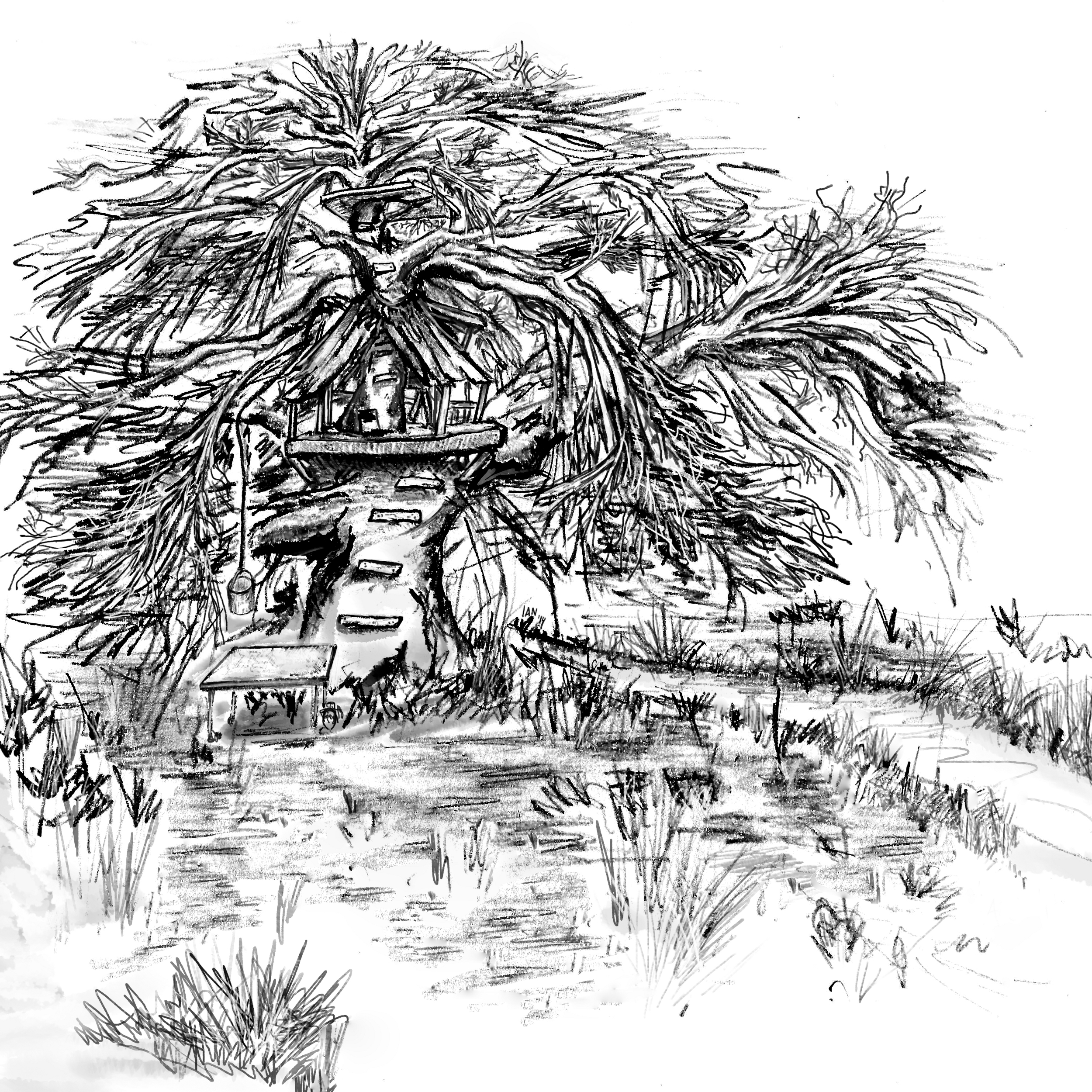
Where did we get our fort-building materials? Everywhere; Reagan had a pile of old scrap wood in his backyard and if that didn’t have what we needed the rest was just a fence hop away, if you know what I mean. The Toones, a family just down the street, were good for nails and if we asked nicely we’d get a handful; Ryan always could muster up twine and rope for the rest of it, and my garage was our tool kit. Sometimes we’d make multiple supply runs a day, back and forth, hauling stuff with wagons, bikes, and occasionally a 3-wheeler; with permission of course. After weeks of hard work, it was done, and to our young eyes it was beautiful. Concealed from the nearby trail, the only hint that its existence was the thin, winding path which we were careful to conceal with dry sagebrush and weeds as we left. (image)

treehouse-web

Here’s a semi-embellished sketch of the finished product. It probably wasn’t quite this nice in real life but it sure seemed like it!

We enjoyed our fort building time and didn’t waste time enjoying our fine handiwork. After a few days of joking, fishing from the limb over the canal, and some knot tying we moved on. I think we wordlessly agreed that the fort was more of a monument to our neighborhood fame than a place to linger for too long. We left it as a place for other kids to stumble upon and be inspired to play and have fun. We ourselves were a restless bunch and when that was all done we packed our tools, hid the trail good and well and took off to the Gully’s lower parts to catch toads.

When we were a little older, the three of us returned to see what had become of our little fortress. With no one to give it the care it needed the tree had grown in places and most of the boards could do with a few more nails. It appeared that someone, or more likely “some ones,” had happened upon it and used it as a place to do things that kids ought not to do. There were beer cans strewn about and scandalous magazines which we quickly dispatched into the canal for the fish to read. We silently said our goodbyes and walked away, regaling each other with stories of Gully days.

That tree was my summer classroom. I learned to work with a team, make compromise, and that hot summer days were better spent hammering away at an unruly nail than dwelling on a couch in front of a television. The experiences we had running through the Gully bonded the three of us together in a unique way that playing Madden could never have. We learned to be active.

In our freshman year of high school Ryan, Mike (an addition to our gang) and I joined the swim team. I know swimming doesn’t have the same spurious reputation as the “real” high school athletes (*cough* ..football..) but we weren’t really worried about that anyhow. We were just doing it for the fun of swimming. We did however get more serious as we participated in heated competition against arch rivals from neighboring schools. We got into the rigorous regimen of an hour of early morning swim practice before school and two hours after. We worked hard and all improved our times. We went to the gym, ran, and ate a great deal of food to have the necessary 3,000 to 6,000 calories to swim one to two miles per day (American Diabetic Association), and eventually all made it to compete at state.

Juxtaposed with this lifestyle we formed, I also had other friends growing up who gave me valuable insights into contrasting upbringings. Nate’s parents seemed a little stricter than most and you might say their family wasn’t exceptionally active. When we played with Nate, we usually sat around playing board games or watching someone play on their Playstation. This is troubling given that couch-dwelling children who watch four hours or more of television per day are likely to have greater body mass index (BMI) than those who watch less than 2 hours per day and that these habits extend into adulthood (Anderson). Additionally, these adolescent habits are key indicators of adult adverse health and illnesses like obesity, high blood pressure, heart disease, diabetes and secondary aging (Boreham; Mcmurray).

Each day I see children everywhere fixated on these magical interactive screens. Our sunday worship services used to be a place where kids couldn’t hold still through an hour meeting, and nobody blamed them. Now, with all children tuned into their devices I don’t have any cover noise in case I accidentally doze off and let out a snore or two. While I worry about the side effect this has on their attention spans, my concern for their waistline is somewhat greater, and those kids are far too good at those games for me to think they only practice at church.

In David Zinczenko’s article, “Don’t Blame the Eater” which was published in the New York Times in 2002 he talks about portly children and how their mass may not be their fault. I tend to sympathize with that notion, but not in the way that people in his camp might think. Zinczenko believes that fast food companies are to blame for the fat plague. While it is true fast food companies have a menu with enough caloric content to fuel an international flight, it’s not about what they offer – it’s about the choices we make here and now. I would look past Nate for his couch conundrum to his parents sitting in front of one of several TVs at their home. And quite possibly this is all more cyclical than we care to imagine; that his parents learned it from his grandparents’ examples, but the buck has to stop somewhere and it’s high time we take our stand here and now. Let kids be kids and love them enough to hurt their feelings by restricting their couch-iPad time; make them dig in the dirt for a while.

Works Cited

Andersen, R. E. “Relationship of Physical Activity and Television Watching With Body Weight and Level of Fatness Among Children: Results From the Third National Health and Nutrition Examination Survey.” JAMA: The Journal of the American Medical Association 279.12 (1998): 938-42. Print.

Boreham, Colin, and Chris Riddoch. “The Physical Activity, Fitness and Health of Children.” Journal of Sports Sciences 19.12 (2001): 915-29. Web.

“Fueling Swimmers.” Student Health Services. American Diabetic Association, n.d. Web. 1 Feb. 2014. <http://studenthealth.ucsd.edu/pdfdocs/swimmers.pdf>.

Mcmurray, Robert G., Joanne S. Harrell, Shrikant I. Bangdiwala, and Jianhua Hu. “Tracking of Physical Activity and Aerobic Power from Childhood through Adolescence.” Medicine & Science in Sports & Exercise 35.11 (2003): 1914-922. Web.

Zinczenko, David. “Don’t Blame the Eater.” Graff, Gerald, Cathy Birkenstein and Russel Durst. They Say/I Say: The Moves That Matter in Academic Writing: with readings. 2. New York: W. W. Norton & Company, 2006. 391-394. Print.

Looking Back

What have you learned about the research writing process?

If there is one thing I’ve learned from our synthesis essay it’s how ideas from different people can be combined into a whole. One exercise we did in class to help us grasp this concept was taking two random pieces that we had previously read and attempted to find commonalities between them and combine them in a way that helps you get your point across. In a group, we chose “How to Mark a Book” by Mortimer Adler and “Are too Many People Going to College” by Charles Murray. One may assume from reading the titles that these essays have little in common, and they’d be right! Initially, it was somewhat of a stretch to put them together but as we found the right talking points it seemed like they were made for each other.

Why are analysis, synthesis, and evaluation important to academic writing?

Analysis, synthesis, and evaluation are the backbone of academic writing. It all revolves around the age old concept of reading what somebody else had written and drawing your own conclusions. It’s what we do. It’s important that we analyze what others have said so that we internalize and comprehend what they mean. After some level of comprehension we are then able to apply these ideas in a new way through synthesis. This helps us form more round, clear and conclusive arguments about the subject matter on which we are able to judge, based on criteria, and choose the most effective solution.

How has your writing and critical thinking improved over the semester?

We’ve read many essays and written something about each one. I believe the number one boon to my writing skills has come through consistent practice and review. I’ve learned that there is so much more to be had from a piece when you dive into it with the purpose of absorbing all the knowledge you can so you can reformulate it into a summary, response, or a work of synthesis; effectively combining the material with your own or others’ ideas. This act of critical thinking is what makes your writing come alive. Writing about what you’re reading in your own words really forces you to not only pay attention but also to internalize the piece so you can sift through and communicate the knowledge in other applications.


The Price of Paper

The Price of Paper

The education industry is booming. Colleges soak up not only government dollars but millions from loan-laden students, totaling $18,796 in revenue per full-time student – that’s a 29% increase over the last 10 years (Kirshstein and HurlBurt 7)! With figures like that I might consider getting into it myself, provided I can finish my degree and avoid declaring bankruptcy. Higher education programs have flourished since the dawn of mandatory public education and even more so after secondary educational institutions became more popular around 1880. Since that time we have seen a huge paradigmatic shift from workforce initiation after basic education to today where nearly 75% of all students graduate with a high school diploma in hand, many of which plan on pursuing a bachelor’s degree (Ebner 23). While I believe this shift to be a positive thing, it does raise concerns about the cost of this new degree-bearing ‘norm.’ Although it sounds good for everyone to have a piece of paper saying they know something, the actual education that it should embody is what is at stake. Education is different than a degree.

Reason 1: Paper Means Nothing

When sorting through a stack of candidates for a new job opening, managers often toss those resumes that under ‘highest education obtained’ don’t prominently display a bachelor’s in whatever. Not that bachelor’s makes a person more qualified for the position; it’s just a sifting tool. Let’s be honest, it may not be all the managers fault that he does this. If you or I were in the same position, would we also not look for something to quickly sort candidates? I think we would, and while sifting is fair play, I’m far from believing the best sieve is a simple bachelor’s degree.

Ideally, proudly presenting an employer with a bachelor’s degree should give one a leg up. Any degree is a mark of achievement, or at least it should be. But just as Mortimer J. Adler in his essay, “How to Mark A Book” says, “having a fine library doesn’t prove that the owner has a mind enriched by books.” Having a bachelor’s doesn’t prove that the owner has a mind bursting with pertinent knowledge. There is a definite distinction between having books and owning books. To truly own a book, you must read it, digest it, and apply the information (Adler). The same goes for degree seekers; they can have one, but that is by no way an indication that they own that knowledge.

Reason 2: Specific Degrees Don’t Matter

Charles Murray sums this idea up in his essay “Are Too Many People Going to College?” He said, “Employers do not value what a student learned, just that the student has a degree,” (Murray 233). Using a degree to sift through qualified candidates makes sense for a job within a chosen field, but when the requirement is just a degree, it means next to nothing about whether that person is qualified for a position, other than they can endure, and do their time. This skill does not warranty their bachelor’s paper has any significant weight to it. It does not mean they own it. Adler said something similar about books that applies, “Full ownership comes when you have made it a part of yourself,” meaning that you have applied and use the knowledge gained.

Here’s an example to illustrate: I have a friend, top of his class and brilliant by any standard, who achieved a bachelor’s in psychology. He was planning on going to graduate school to further his education and one day help people with that knowledge, but psychology is a popular degree right now and the programs he tried to get into were full. In need of a job to support his family, he applied at a local credit union. The credit union required anybody applying for an account managerial position to hold a bachelor’s degree to merely be considered. No, not a degree in accounting, business, sales, finance, or even economics; just a degree. He of course got the job and has since been doing well.

Reason 3: Supply and Demand

There is a simple law that everyone who studies economics, and probably everybody else in the world, has heard of. It’s called “supply and demand.” bachelor’s degrees are no exception to this law. The more that are out there and the higher the market saturation, the less demand there is. Unemployment among bachelor’s degree holders is not promising. Susannah Snider talks about bachelor’s graduate unemployment in her article, “Think Outside the College Box,” saying, “The unemployment rate for bachelor’s degree recipients between the ages of 20 and 24 is 5.9%, lower than the national unemployment rate, but a discouraging statistic for those who assumed a degree would result in an immediate paycheck,” (Snider 58).This trend may perhaps be the basis for Charles Murray’s essay “Are Too Many People Going to College?” Murray may be looking at the developing norm of everybody aiming to get a bachelor’s degree and starting to worry if this means losing out on other essential professions. And if, because of market saturation, a bachelor’s is worth less, are other, maybe blue-collar positions, worth more? Remember, when everybody has the same super power then no one is special.

Reason 4: The Price of Paper

In 2008 we witnessed the bursting of a huge economic bubble in the real estate market, for many carrying long-lasting economic effects. As college prices continue to inflate, some question whether the post-secondary education isn’t the next bubble to burst. Brian Kelly in his article, “Is College Still Worth It?” says, “If colleges were businesses, they would be ripe for hostile takeovers, complete with serious cost-cutting and painful reorganizations,” (8). Regardless, year after year students pay more for their education. To pay for rising tuitions students have to take on loans that can be “roughly the median price of a home,” (Kelly 8). What choice do I have? A question many feel faced with. Society is pressuring us into getting a bachelor’s because that’s what you’re supposed to do. Might I offer a few alternatives to offset the cost of college:

  1. Take a free online course. If learning is the most important factor, there are literally hundreds of free, no-credit classes that anyone can take from top universities such as MIT, Yale, Harvard, Oxford, and Stanford, just to name a few. These classes are taught by professors and often include the textbook and course materials free. Many of them really grade their students’ papers and tests. Although you may not walk away with an Ivy League school credit, most of them will supply you with a certificate of completion.
  2. Pick up a certificate. Attending a trade program and getting a certificate in a chosen vocation is just as viable a means to provide as a bachelor’s degree in many instances.
  3. Get an Associate’s degree. Two year programs at community colleges can save you loads of money in the long run, and still get you into a higher paying position than just a high school diploma alone. Another surprising fact about associate’s degrees: according to Georgetown University’s Center on Education and the Workforce, nearly 30% of Americans with associate’s degrees now make more money than those with bachelor’s degrees (Marcus).
  4. Take two and transfer. Taking two years at a community college and then transferring to a four-year institution can save a lot of money, considering community colleges’ tuition rates are often rock bottom. Additionally, students who enroll first in a community college and then transfer to a four-year program are two times as likely to finish and do better than their peers who went straight from high school to a four-year university.

These options not only save time and money but are counted among post-high school credentials which will increase overall lifetime earnings (Gewertz). For example, Associate’s degree recipients earn about 24% more than high school graduates during their working life (Snider 60).

Paper for Thought

Do not misunderstand; college still makes sense for many people. It oftentimes has a very positive impact on the rest of their lives, not only economically, but also for the academic growth and new relationships and ideas fostered. I do, however, believe that placing a college bachelor’s degree in the same category as a high school Diploma is wrong. Are we creating a culture of self-demeaning people who are down on themselves if they don’t have what it takes to attend and finish college? If we continue to push a bachelor’s degree into the norm we risk alienating, or worse, convincing those, whose contribution may be more helpful in a different industry, to fit in and get just get the paper.

Sources:

Adler, Mortimer J. “How to Mark a Book.” The Radical Academy (1940).

Ebner, Tim. “Graduation in the United States.” Education Week (2013): 23-27. Academic Search Premier. Web. 26 November 2013.

Gewertz, Catherine. “‘College for All’ Reconsidered: Are Four-Year Degrees For All?” Education Week (2011): 6-8. Academic Search Premier. Web. 6 November 2013.

Kelly, Brian. “Is College Still Worth It?” U.S. News & World Report (2010): 6-12. Academic Search Premier. Web. 6 November 2013.

Kirshstein, Rita J. and Steven HurlBurt. Revenues: Where Does the Money Come From? Data Brief. AIR. Washington: American Institutes for Research, 2012. Document. <http://www.deltacostproject.org/pdfs/Revenue_Trends_Production.pdf&gt;.

Marcus, Jon. Community college grads out-earn bachelor’s degree holders. Ed. Rich Barbieri, et al. 26 February 2013. CNN Fortune & Money. 3 December 2013. .

Murray, Charles. “Are Too Many People Going to College?” Graff, Gerald, Cathy Birkenstein and Russel Durst. They Say/I Say: The Moves That Matter in Academic Writing: with readings. 2. New York: W. W. Norton & Company, 2006. 222-224. Print.

Snider, Susannah. “Think Outside the College Box.” Kiplinger’s Personal Finance (2013): 58-60. Academic Search Premier. Web. 6 November 2013.

Moderating Future Shlock

One afternoon after work, a colleague of mine and I sat outside the office and, as we often did, contemplated the world around us. We got onto the topic of Big Brother and seeing Orwell’s ideas creep up in the world around us. It was then that he introduced me to some of the ideas Aldous Huxley wrote about in his book “Brave New World.” I had never before considered the possibility that it may not be through an ever-present, ever stronger government that our subjection comes but through our own selves; becoming complacent through entertainment.

Available on amazon. I highly recommend it!

Brave New World, Aldous Huxley

Neil Postman is the author of the book “Conscientious Objections: Stirring Up Trouble about Language, Technology, and Education” which was published by Knopf 1988. Postman Writes about the defeat of intelligence through what he and his colleagues call “Future Shlock,” adapted from his colleagues’ term ‘Future Shock’ which is “a way of describing the social paralysis induced by rapid technological change.” Postman uses the example of Hitler’s Germany before and during the second World War to highlight just one form of the social and intellectual degradation that befalls a society that allows itself to lose its agency. Postman himself writes, “this is what I wish to call to your notice: the frightening displacement of serious, intelligent public discourse in American culture by the imagery and triviality of what may be called show business. I do not see the decline of intelligent discourse in America leading to the barbarisms that flourished in Germany, of course… There are other ways to achieve stupidity, and it appears that, as in so many other things, there is a distinctly American way.” He goes on to explain that this American way is being ruined “not by what we fear and hate but by what we welcome and love.”

Postman himself brings up the differences between Orwell’s future and Huxley’s. He says that in Orwell’s people are controlled by inflicting pain but in Huxley’s they are controlled by inflicting pleasure. I agree with Postman that America’s future is not in totalitarian rule of a dictator but by steady doses of pleasure that lull is into a thought coma. While I agree that this is a more likely fate of our America I think that Postman’s views are a little extreme. Don’t misunderstand me when I say that; Postman’s voice is a clear warning and sometimes loud hellfire, condemnation and disaster is how the people need to hear it – it takes a lot to get through all those layers of desensitization to today’s problems – but his views are just a little overbearing.

Huxley’s future is not secured and while Postman is stuck with his head in a damp barrel, we all can make educated and informed decisions about how we deal with and moderate entertainment. There is danger in entertainment and I stress that straight and true word: moderation. Moderation is the compass to navigate the sea of entertainment in which we find ourselves. Instead of succumbing to the zombification that media can induce, use good judgment and say to yourself, “that’s enough, it’s time to go out.” As Postman himself puts it, “I [do not] make a complaint against entertainment. As an old song has it, life is not a highway strewn with flowers. The sight of a few blossoms here and there may make our journey a trifle more endurable.” It is not that media is inherently bad. No, it has its merits. It is that living through media is the cord that will bind us to the Huxleyan prophecy. Be free from bondage. Moderate yourself and your time. Be your own master and master your own will.

Here’s a link to Neil Postman’s essay: http://169.204.228.86/OurSchools/Hs/staff/jvoigt/APLanguage/Film%20Studies/NeilPostmanFutureShock.pdf